delogogreensq.jpg (6834 bytes)

Driving Essentials, Inc.
for the carriage enthusiast ~ and other fine gifts

800-622-8543

Home

Search

Contact Us

Our Location

Carriages in Stock    New Products     All Driving Equipment    Books & Videos     Gifts & Jewelry
Glinkowski Carriages   Shows & Trade Fair Schedule   Driving Rules, Tests, Links   Sponsorships-FEI Top Driver   Essential Registry

Driving Bit Essentials
Back to Bits Index Page   

DRIVING BITS - AN OVERVIEW
Driving bits come in a variety of cheek types and mouthpieces to suit any type of horse, situation, or turnout.

CHEEK TYPES -  see below for Mouthpieces

Click Here
To See Rein Settings

LIVERPOOL – The most widely used of all driving bits. It can be made in a variety of mouthpieces with fixed or swivel cheeks. Fixed cheeks do not allow the cheeks to swivel and are designed to be used with a pair of horses. This avoids the pinching of the lips that can occur with the coupling reins. With swivel cheeks, the mouthpiece can be made to slide up and down. A sliding mouthpiece is often preferred because it tends to keep the mouth more responsive. Accompanied by a curb chain, the Liverpool bit offers a variety of rein settings for maximum adjustability.

POST or BUTTERFLY – Can be made with a variety of mouthpieces. Offered in either a 2 loop or 3 loop version, although rein placement is fairly limited.
BUXTON – Elaborate in appearance, these bits are reserved for formal turnouts such as a Gig, Mail or Stanhope Phaeton, Park Drag, or a coachman driven carriage. The cheeks are curved at the middle slot and are joined below the bottom slot by a curved bottom bar. Fixed or swivel cheeks are available as well as a variety of mouthpieces. MILITARY or ELBOW – The cheeks are set back at a square angle so that a horse can’t seize the bit with his teeth or lips. This cheek design also prevents pinching of the lips which makes it well suited for pair driving. The action is very similar to the Liverpool and is also available in a variety of mouthpieces.
HALF-CHEEK LIVERPOOL – A variation on the Liverpool cheek. Useful when used with a pair of horses by eliminating the pinching that can occur with the action of the coupling rein. WILSON SNAFFLE – A loose ring snaffle with the addition of two floating rings inside the cheek rings for attaching the cheekpieces of the bridle. Reins are usually attached to both rings. If the reins are attached to the fixed rings only, this bit can become very severe, as it tends to press the horse’s face between the cheekpiece rings.

MOUTHPIECES
Back to Top

SIMPLE JOINTED SNAFFLE – Acts on the tongue and bars with a pinching or nutcracker action. Rein pressure is transferred directly onto the horse’s mouth. Applied pressure can’t be increased without the use of a pulley device, such as draw reins.
FRENCH LINK SNAFFLE – The small link in this double jointed mouthpiece gives a softer nutcracker action than a single jointed mouthpiece.
EGG LINK SNAFFLE – Similar to a French Link. The oval shape of the link puts pressure on the tongue while reducing the nutcracker action.
STRAIGHT MOUTH or STRAIGHT BAR – More pressure is borne by the tongue than the bars. The mouth may be reversible, plain on one side and serrated on the other side. A mouthpiece that is smooth on both sides is also available.
MULLEN MOUTH – The mouthpiece is curved outwards to allow more room for the tongue. Pressure is thereby increased on the bars, especially on the outer sides.
ARCH MOUTH – The mouthpiece is curved upwards instead of outwards like the Mullen. The action however is similar.
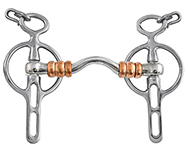
GLORY – Curved mouthpiece makes this bit a hybrid between a Mullen and Arch Mouth. The copper alloy mouthpiece promotes salivation for a more responsive mouth. Available in a 2-loop butterfly, 2-slot fixed liverpool, or 2-slot swivel liverpool cheek.
VULCANITE – A hard, black vulcanite rubber that provides a thick Mullen Mouth with a mild effect.
CHERRY ROLLER – A Straight Mouth with a series of copper or stainless steel rollers that encourage the horse to mouth the bit. A horse can’t take hold of this bit because the rollers just slip away.
FIGURE EIGHT – The rotating double-ring attachment prevents the tongue from getting over the bit.
NAGBUTT – Prevents the tongue from getting over the bit. The plate lies to the back of the throat and keeps the tongue in place.

PORT MOUTHPIECES
There are basically two types of ports, those that reduce tongue pressure and those that act upon the roof of the mouth.
Back to Top

LOW PORT MOUTH – Relieves pressure on the tongue.
HIGH PORT MOUTH – Allows room for the tongue and also is designed to act on the roof of the mouth.
SEGUNDO – Provides room for the tongue and is shaped to conform to the contours of the horse’s palate.
LOW PORT WITH PLAYERS– Keys encourage interest and mouthing, especially useful in keeping a young horse’s mouth moist and his jaw relaxed.
HANOVERIAN – A high port with the addition of rollers is available as a jointed or fixed mouth. The rollers promote play and mouthing while the hinged port prevents the horse from getting his tongue over the bit.

COSCOQUERO – Curved mouthpiece with a high port that acts on the roof of the mouth. The copper wheel gives the opportunity for play to keep the horse’s interest.

Back to Top

 
Carriages in Stock     New Products     All Driving Equipment      Books & Videos    Gifts & Jewelry
Glinkowski Carriages   Shows & Trade Fair Schedule   Driving Rules, Tests, Links   Sponsorships-FEI Top Driver   Essential Registry

**Prices Subject to Change from those published**         Shipping Information          Privacy and Security          Return Policy
©1998 - 2008 Driving Essentials, Inc.  All rights reserved.  The Driving Essentials logo and maker's mark are trademarks of Driving Essentials, Inc.